

Contents
- History and Cultural Significance
- Architectural Layout and Spatial Organization
- The Assembly Space
- The Monikut
- Ghaai Khutaa (Lai Khuta)
- Architectural Evolution and Materiality
- Roofing and Acoustics
- Structural Engineering and Climate Adaptations
- Socio-Religious and Cultural Functions
- Spiritual Congregations
- Bhaona (Indigenous Theater)
- Community Food Service and Civic Infrastructure
- Summary of the Living Tradition
Namghar
A Namghar (Assamese: নামঘৰ, literally "House of Names") is the traditional prayer house and community center central to the Ekasarana Dharma (Vaishnavism) of Assam, India. Introduced in the 15th century by the saint-reformer Srimanta Sankardeva (1449–1569) during the Bhakti movement, Namghars serve as congregational spaces where devotees gather to sing, recite scriptures, and chant the names of God.
Beyond their primary religious role, Namghars function as vital socio-cultural, political, and educational hubs, forming the core infrastructure of Assamese village life.
History and Cultural Significance
The concept of the Namghar was introduced by Srimanta Sankardeva as an egalitarian space for spiritual and community gathering, breaking away from orthodox Brahminical caste exclusions. Over the centuries, Namghars became deeply woven into the rural Assamese identity. In regions like the Nagaon and Barpeta districts, nearly every Hindu village houses at least one, and often several, public Namghars. The identity and social life of village residents are intimately tied to the specific Namghar they attend.
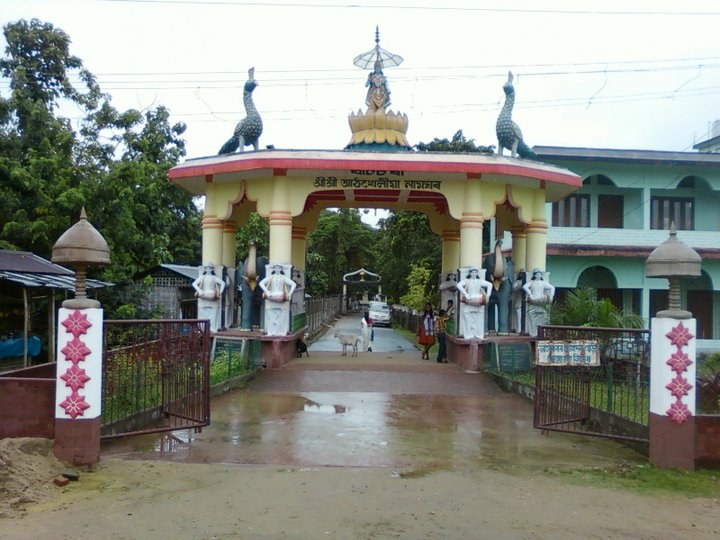
A prominent historical example is the Kirtan Ghar located within the Barpeta Satra in the town of Barpeta, which stands as an ancient and highly revered center of the Vaishnavite tradition.
Architectural Layout and Spatial Organization
Namghar architecture is uniquely tailored to its spiritual purpose, indigenous materials, and regional climatic requirements. The structure is strictly oriented along an east-west principal axis.
The Assembly Space
The main section of the Namghar is a large, longitudinal congregation hall where devotees sit on the floor during services. Devotees sit in this hall facing east toward the sanctuary.
The Monikut
Situated at the easternmost end of the complex is the Monikut (literally, "jewel hut"), a smaller structure that serves as the inner sanctuary. The Monikut houses the Xinhaaxon (altar or throne) upon which sacred texts—most notably the Kirtan Ghoxa or Bhagavata—are placed instead of anthropomorphic idols.
Architecturally, the Monikut is a darker, enclosed room featuring a hipped or gabled roof with either small windows or no windows at all. To maintain a sense of mystery and veneration, entry into the Monikut is traditionally restricted to community spiritual leaders (Satradhikars) and designated elders.
Ghaai Khutaa (Lai Khuta)
Within the assembly hall, a specific structural column holds profound sacred significance. Known as the Ghaai Khutaa or Lai Khuta (Main Pillar), this oversized column is located on the northern-eastern side of the hall. The floor surrounding its base is slightly raised, and it is traditionally wrapped with a Gamosa—a white, hand-woven cotton cloth featuring distinctive red borders and floral motifs.
In Assamese folklore, this pillar is considered the seat of the Burha-Dangoria (a protective holy spirit). As a matter of strict custom, no one is allowed to sit directly next to this pillar, and it receives the first offering of Mah-Prasad (sacred food) during religious services.
Architectural Evolution and Materiality
The construction of public Namghars presents a distinct departure from the massive, enclosed stone temple architecture seen elsewhere in India. Designed to withstand the intense humidity, high temperatures, and seasonal monsoons of Assam, traditional Namghars emphasize openness and natural ventilation.
Roofing and Acoustics
Historically, the primary architectural element of a Namghar was its massive thatched roof, supported by timber or bamboo poles over a mud floor. The roof featured bamboo rafters covered by a woven bamboo sub-roof (saal) and topped with dried grass blades. This design provided high thermal resistance and exceptional acoustics. The exposed thatched underside functioned as a highly efficient noise-absorbing ceiling, boasting an estimated Noise Reduction Coefficient (NRC) close to 1.0. This acoustic absorption was essential for dampening the loud, piercing metallic echoes of the Taal or Bhor Taal (large bronze cymbals) used during communal chanting.
In the late 20th century, modern building trends saw a transition from thatch to corrugated galvanized iron (tin) roofing, and mud floors were progressively replaced with cement. While cement floors improved durability, tin roofing introduced challenges like indoor heat, glare, and poor acoustic insulation during heavy rains and cymbal performances. To retain their community function, modern cement floors frequently leave a central, longitudinal strip unpaved and earth-filled to provide a safer, less slippery footing for actors moving during traditional performances.
Structural Engineering and Climate Adaptations
Traditional rural builders often lacked a formal understanding of structural bracing. Because support columns were buried directly into the damp earth, they frequently fell victim to termite damage and rot. Consequently, when the severe spring storms of Assam—known locally as Bordoisila—swept through the region, unbraced Namghars would regularly lean to one side, taking on a distinct rhomboid profile. Today, the utilization of reinforced concrete pillars has largely resolved this cyclical structural vulnerability.
Socio-Religious and Cultural Functions
Spiritual Congregations
Unlike many South Indian temple complexes designed for daily individual visits, public village Namghars function primarily as spaces for congregational assemblies during major religious milestones, festival seasons, and communal memorial services. Private family Namghars exist alongside public ones, serving as smaller personal chapels within domestic compounds.
Bhaona (Indigenous Theater)
Namghars serve as the native theaters for Bhaona, a traditional form of folk opera created by Srimanta Sankardeva to visually communicate mythological narratives to the public. During a Bhaona performance, spectator crowds regularly overflow the main hall. In rural or remote areas lacking electrical access, these evening events are traditionally lit by lanterns.
Community Food Service and Civic Infrastructure
The distribution of holy food offerings, known as Mah-Saul (a mixture of soaked green lentils, ginger, and seasonal fruits), follows strict community guidelines. The food is prepared across eligible households within the community rather than in a central temple kitchen. The individuals tasked with handling and serving the food are known as Deuris or Deus, a highly privileged selection based on spiritual knowledge and communal standing. Because of this decentralized system, traditional Namghars historically lacked built-in kitchens or pantries.
Similarly, historical Namghars lacked extensive public restroom facilities, save for occasional screened sections designated for women. For water supply and ritual purification, Namghars were systematically constructed on the immediate banks of a village pond, ensuring an accessible source for washing and cleansing before entering the sacred space.
Summary of the Living Tradition
All in all, the architecture of the Namghar represents a localized, sustainable, and highly deliberate response to the spiritual and social requirements of the people of Assam. Because traditional structures were composed of perishable materials that required periodic rebuilding, historical architecture from the medieval era did not survive in static, physical permanence.
However, this structural impermanence allowed the Namghar to thrive as a flexible, living architectural form—one capable of evolving alongside successive generations of communities, distinct from the massive masonry traditions found elsewhere in the Indian subcontinent.